Body Signals After Trauma: Your Body Knows Something Your Mind Can’t Quite Name
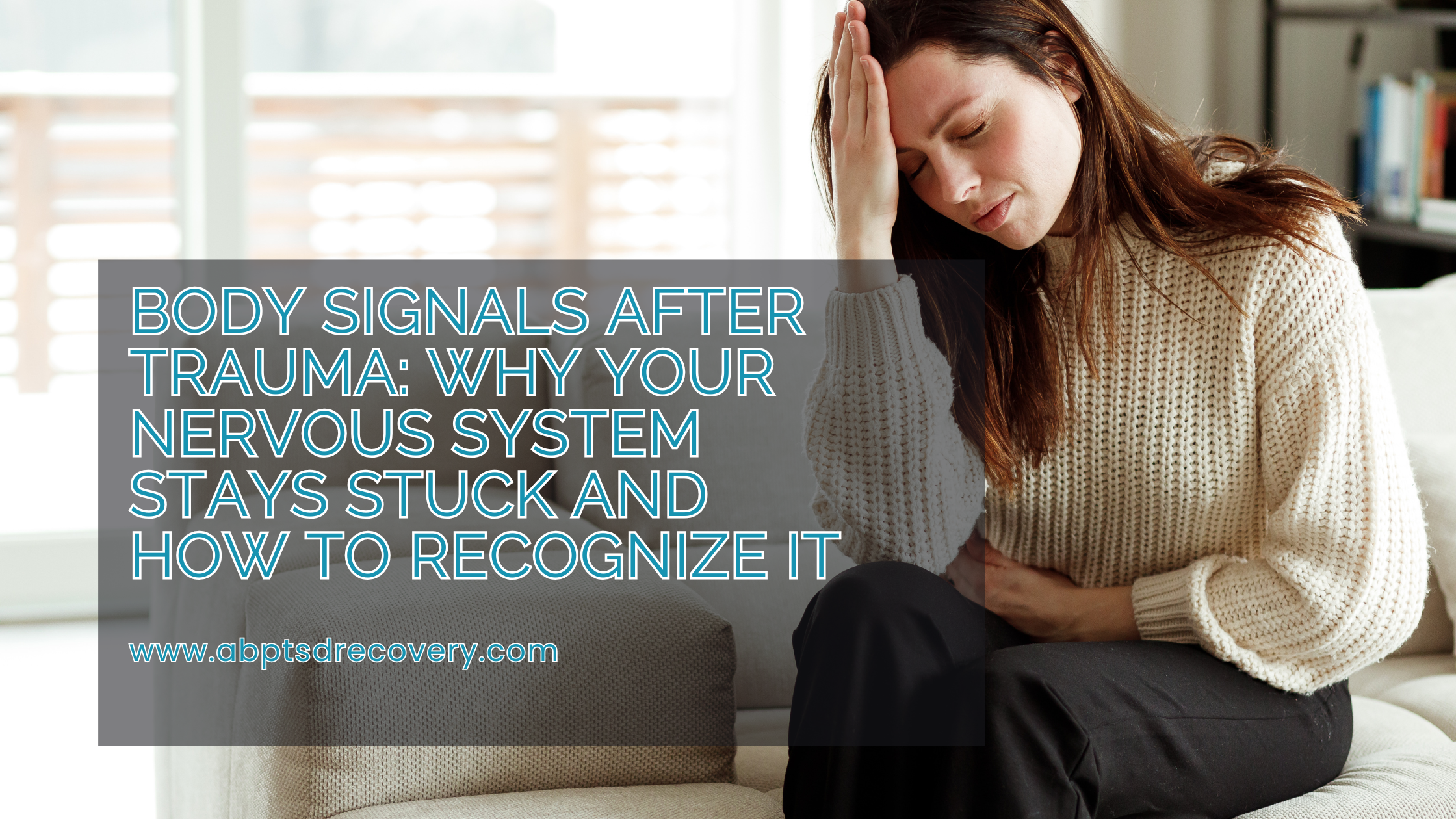
You notice your shoulders are permanently up by your ears. Your jaw is so clenched that your dentist commented on it at your last appointment. Your neck is tight. Your chest feels constantly restricted, like there’s a band wrapped around your ribs.
Or maybe it’s different. Your hands shake when you reach for something. Your legs feel weak, unreliable. You have chronic pain that doctors can’t quite explain—your lower back, your joints, your neck. Some days it’s unbearable.
Or the startle response: someone comes around a corner and your entire body jumps. A loud sound sends electricity through your system. A sudden touch makes you flinch before you even know what’s happening.
Your mind might be telling you, “That’s not a big deal, calm down.” But your body isn’t listening. Your body is stuck. And the worst part? You can’t seem to fix it, no matter how many times you tell yourself you’re safe, or how much yoga you do, or how many relaxation apps you download.
This isn’t weakness. This isn’t you being “too sensitive.” Your body isn’t broken.
Your body is doing exactly what it learned to do when trauma happened. And right now, it doesn’t know how to stop.
What Trauma Does to Your Body
Trauma doesn’t just live in your memory. It lives in your nervous system, and your nervous system lives in your body. Understanding this changes everything about how you approach healing.
When you experienced trauma—whether it was one overwhelming event or years of chronic threat—your body went into survival mode. Your nervous system activated its ancient emergency protocols. Adrenaline flooded your system. Your muscles tensed, ready to fight or run. Your breathing got shallow. Your digestive system shut down. Your mind narrowed to one thing: survival.
This response saved your life. Your nervous system did exactly what it was supposed to do.
The problem is, even though the trauma is over, your body didn’t get the memo. Your nervous system is still reading the world as dangerous. And so it stays in a low-level state of emergency, ready to activate that survival response at any moment.
This is where all those body signals come from.
The Five Body Signals That Tell You Trauma Is Stuck
These are the signals clients in Edmonton describe most often. If you recognize yourself, know that these are normal responses to abnormal experiences. Your body isn’t malfunctioning. It’s just stuck in a protective pattern.
1. Chronic Muscle Tension and Rigidity
This is the most common one. Your muscles are constantly tight, especially in your neck, shoulders, jaw, and lower back. You might feel like you’re bracing against something all the time.
Why this happens: When your nervous system is in survival mode, it keeps your muscles primed for action. Muscles need to be ready to fight or run, so they stay contracted. This happens automatically—you’re not doing it consciously. Your nervous system decides your body needs to stay ready, and so it does.
What it feels like:
- Constant tension, like your muscles never fully relax
- A sensation of being perpetually “wound up”
- Pain that doesn’t correspond to injury or overuse
- Headaches that start in your neck and shoulders
- Feeling like you’re held in a permanent clench
- Sometimes a sensation of being “trapped” in your own body
This is exhausting. Holding your muscles in a state of tension for months or years takes a toll. Many people develop chronic pain conditions directly from this sustained tension. Your nervous system is literally draining your body’s resources.
2. Tremors, Shaking, and Involuntary Movements
Your hands shake when you hold a cup of coffee. Your legs bounce when you sit. You get tremors—little shakes that come and go without your control. Sometimes your whole body trembles.
Why this happens: Tremors are often a sign of incomplete survival response. During trauma, your body wanted to fight or run—to move violently, to discharge all that emergency energy. But many people can’t do that in the moment. You’re frozen, or trapped, or it’s not safe to fight back. So the impulse to move gets stuck, literally trapped in your nervous system.
Tremors are your nervous system trying to complete that response, even years later. Your body keeps trying to finish what it couldn’t finish during the trauma.
What it feels like:
- Shaking in your hands, especially when you’re stressed or tired
- Restlessness, an inability to sit still
- Twitches or tremors that seem random
- Feeling like your body is vibrating from the inside out
- Sometimes it’s visible; sometimes only you can feel it
3. Chronic Pain Without Clear Cause
You have persistent pain in your body—lower back pain, joint pain, neck pain, sometimes pain that moves around. You’ve been to doctors, had imaging done, and there’s no structural damage. Nothing explains it.
Why this happens: This is called somatic pain, and it’s completely real. When your nervous system is stuck in survival mode, it produces physical pain as a way of protecting you. Pain makes you stay alert. Pain keeps you from engaging with the world too much. Pain is a protective signal.
Additionally, when your muscles are chronically tense, they can develop trigger points and perpetuate pain cycles on their own. Tight muscles restrict blood flow and create oxygen debt in the tissues, which creates pain.
But here’s the key: the pain is real, it just doesn’t come from structural damage. It comes from your nervous system’s ongoing emergency state.
What it feels like:
- Constant aching or soreness
- Pain that changes location or intensity
- Pain that gets worse with stress and better with rest
- A sense of “my body hurts but nothing’s broken”
- Sometimes sharp pain, sometimes a dull ache
- Pain that doesn’t respond to typical pain management (rest, stretching, over-the-counter pain relief)
4. Exaggerated Startle Response
Someone comes up behind you and you nearly jump out of your skin. A loud noise and your entire body reacts—heart racing, breath shallow, a surge of adrenaline. A touch from someone, even someone you love, makes you flinch.
Why this happens: Your amygdala, the alarm center of your brain, has been recalibrated. It’s now set to a much lower threshold for threat detection. Sounds that most people ignore register as potential danger. Sudden movement registers as a threat. Your nervous system is hypervigilant, constantly scanning for signs of danger.
When something unexpected happens—a sound, a movement, a touch—your amygdala fires instantly, before your thinking brain can evaluate whether there’s actual danger. This is why you can’t logic your way out of it. It’s not a choice; it’s an automatic survival response.
What it feels like:
- An instant, full-body reaction to sudden stimuli
- Your heart racing even after you’ve realized there’s no danger
- Feeling like your body reacts before your mind catches up
- Difficulty being touched unexpectedly
- Jumping at sounds that others don’t even seem to notice
- Feeling embarrassed because your reaction feels “too much”
- Hypervigilance—constantly scanning your environment for threats
5. Shallow Breathing and Chest Tension
Your breathing feels restricted. You often catch yourself holding your breath. Your chest feels tight, like there’s weight on it. Sometimes you feel like you can’t get a full breath.
Why this happens: During trauma, breathing changes. It becomes shallow, rapid, held. Your nervous system does this to prepare for action. But trauma can teach your nervous system to keep breathing restricted, even when you’re safe.
Additionally, when your chest and shoulder muscles are chronically tense, they restrict your breathing mechanically. The muscles of your rib cage can’t move freely, so you can’t take full breaths.
Restricted breathing also keeps your nervous system activated. When your nervous system senses shallow breathing, it interprets that as continued threat. So it stays in survival mode, which keeps your breathing shallow. It becomes a cycle.
What it feels like:
- Difficulty taking a full breath
- Feeling like you need to consciously remind yourself to breathe
- Chest tightness or heaviness
- A sensation of restriction around your ribs
- Sometimes lightheadedness or dizziness from not breathing deeply enough
- Panic episodes that include gasping for breath
Why These Signals Don’t Just Go Away
This is important to understand: willpower and logic don’t fix these signals. You can’t think your way out of them. You can’t relax your way out of them. You can’t stretch or massage or medicate your way out of them permanently.
Why? Because these signals are coming from your nervous system’s implicit (automatic) memory, not your explicit (thinking) memory. Your nervous system learned these responses through direct experience of threat. And it will keep running these responses until it learns something new.
You can temporarily suppress these signals. You can white-knuckle through them. You can breathe slowly and calm your thinking mind. But as long as your nervous system still believes you’re in danger, it will keep sending these signals.
Your nervous system has to learn that you’re safe. Not your conscious mind—your nervous system itself. And that learning doesn’t happen through insight or willpower. It happens through somatic processing: working directly with your nervous system and your body.
The Difference Between Managing Symptoms and Resolving Them
Many people try to manage these body signals:
- Stretching and massage for the tension (temporary relief, but the tension returns)
- Deep breathing apps for the chest tightness (helps for a moment, but doesn’t address the underlying activation)
- Startle reduction through gradual exposure (sometimes helps, but often just teaches you to tolerate startle better, not eliminate it)
- Pain medication for the chronic pain (numbs it, but doesn’t resolve it)
These strategies aren’t bad—they can help you survive day to day. But they’re symptom management, not resolution. Your nervous system is still stuck. The signals will keep coming back.
Actual resolution requires your nervous system to process and integrate the trauma. To release the protective patterns. To update its threat assessment.
This is why somatic therapy, particularly approaches like EMDR that work directly with how your nervous system processes trauma, is so effective. It’s not trying to manage the symptoms. It’s addressing the root: your nervous system’s stuck trauma response.
How Your Body Heals: Somatic Processing and Nervous System Integration
Healing happens when your nervous system completes what got interrupted during the trauma.
Remember those tremors we talked about? Those are your body trying to discharge the incomplete survival response. Somatic therapy doesn’t fight that. It supports it. By bringing awareness to your body, by gently encouraging your nervous system to complete those interrupted movements, you allow your body to finish what it couldn’t finish during the trauma.
When you work with a trauma-informed somatic therapist, you’re essentially teaching your nervous system a new response. You’re bringing awareness to your body’s signals. You’re showing your nervous system that you’re paying attention, that you’re present, that the threat is actually over.
And as your nervous system updates its threat assessment, something remarkable happens: the body signals start to shift. The chronic tension begins to release. The tremors settle. The startle response becomes less hair-trigger. The pain diminishes. Your breathing deepens.
It doesn’t happen overnight. But it does happen.
EMDR therapy is particularly effective for this because it directly processes the trauma memory in a way that your nervous system understands. During EMDR, you’re activating the traumatic memory while your brain is guided through bilateral stimulation (typically eye movements, but also tapping or sounds). This unique combination allows your nervous system to reprocess the memory, to discharge the stuck survival energy, and to move beyond the trauma.
Many clients notice changes in their body during or shortly after EMDR sessions: the tension releases, they take a deeper breath, they feel less on edge. Their nervous system is beginning to understand that the threat is over.
Somatic therapy works more gradually and directly with the body. A somatic therapist helps you develop awareness of your body’s signals, notice patterns, and gently work with the protective responses your nervous system has created. Over time, as you build this awareness and your nervous system learns that you’re paying attention and that you’re safe, the stuck patterns begin to release.
What to Look for in Your Own Body
Start paying attention to these signals. Not to judge yourself or think you’re broken, but to gather information. Your body is trying to communicate with you.
Ask yourself:
- Where is tension showing up in my body?
- When do I notice my startle response most?
- What does my breathing feel like right now?
- Are there involuntary movements (tremors, bouncing legs)?
- Where do I experience pain, and does it change with my stress level?
This awareness itself is healing. When you notice these signals with compassion rather than judgment, you’re beginning to work with your nervous system rather than against it.
The Path Forward
If you recognize these body signals in yourself, know that this is not your fault, and you’re not broken. Your body is doing exactly what it learned to do. And the good news is: nervous systems can learn new things.
Healing from trauma-related body signals requires working with approaches that address your nervous system directly. Talk therapy alone won’t do it. Willpower alone won’t do it. But trauma-informed somatic work, particularly EMDR, has a strong track record of helping your nervous system finally release what it’s been holding.
When your nervous system learns that you’re actually safe, your body will follow. The tension will release. The startle response will settle. The pain will diminish. You’ll get your body back.
ABOUT DR. CANDACE HAMILTON
 Dr. Candace Hamilton, Psy.D, Registered Psychologist, EMDR Consultant specializes in somatic trauma therapy—working directly with how trauma lives in your body and nervous system. Her approach combines EMDR therapy with somatic awareness and body-based interventions to help clients release the physical patterns trauma creates and restore their sense of safety and presence in their own bodies.
Dr. Hamilton is particularly skilled in working with clients who experience chronic tension, dissociation, and complex trauma responses that show up physically. She’s an EMDRIA-Approved Consultant and CE Provider (#24058), and brings both clinical expertise and genuine compassion to the work of nervous system healing.
She works with individuals across Edmonton and throughout Alberta via virtual sessions.
Learn More About EMDR with Candace
ABOUT THE INTEGRATIVE TRAUMA & PTSD RECOVERY CENTRE
The Integrative Trauma & PTSD Recovery Centre (ITC) is a trauma-focused practice in Edmonton, Alberta, specializing in EMDR therapy, intensive trauma work, and somatic approaches to healing complex trauma and PTSD.
Our Services Include:
- Intensive Trauma Therapy (concentrated multi-day or multi-week programs)
- Individual Therapy for Trauma Recovery
- Couples Therapy (relational and betrayal trauma)
- Children & Family Therapy
- Group Therapy for Trauma Recovery
- EMDR Therapy
- Training & Consultation for Clinicians
Service Area:
- In-person therapy: Edmonton, Alberta
- Virtual therapy: Available to residents across Alberta
Location: Unit 202A, 9129 35 Avenue NW Edmonton, AB T6E 5Y1
Contact: Phone: (587) 415-8385 Email: info@abptsdrecovery.com Website: abptsdrecovery.com
Body Signals After Trauma: If your body is holding signals of trauma—tension, pain, tremors, or exaggerated startle—somatic therapy can help. Your nervous system can learn that it’s safe.
Book a free 15-minute consultation to explore whether EMDR or somatic therapy is right for you. Link in bio, or reach out directly at (587) 415-8385.
Relevant Blogs
- The Window of Tolerance: Understanding Your Nervous System’s Comfort Zone
- Is an EMDR Intensive Right for You? Six Questions to Ask First
- Understanding Dissociation and Memory Gaps After Trauma