
Have You Noticed Your Reactions Don’t Always Match the Moment?
You’re at the grocery store and someone taps your shoulder to ask where the milk is. Your heart jumps into your throat. A car alarm goes off down the street and you feel like your body’s on fire. Or the opposite—someone’s telling you something important and you’re so numb you can barely feel anything at all.
These aren’t character flaws. Your nervous system is doing exactly what it was wired to do after trauma. It’s just… doing it a little too aggressively, or not doing it at all.
This is where the concept of the window of tolerance comes in. It’s one of the most helpful ways to understand what’s happening in your body after trauma, and why healing matters so much.
What Is the Window of Tolerance?
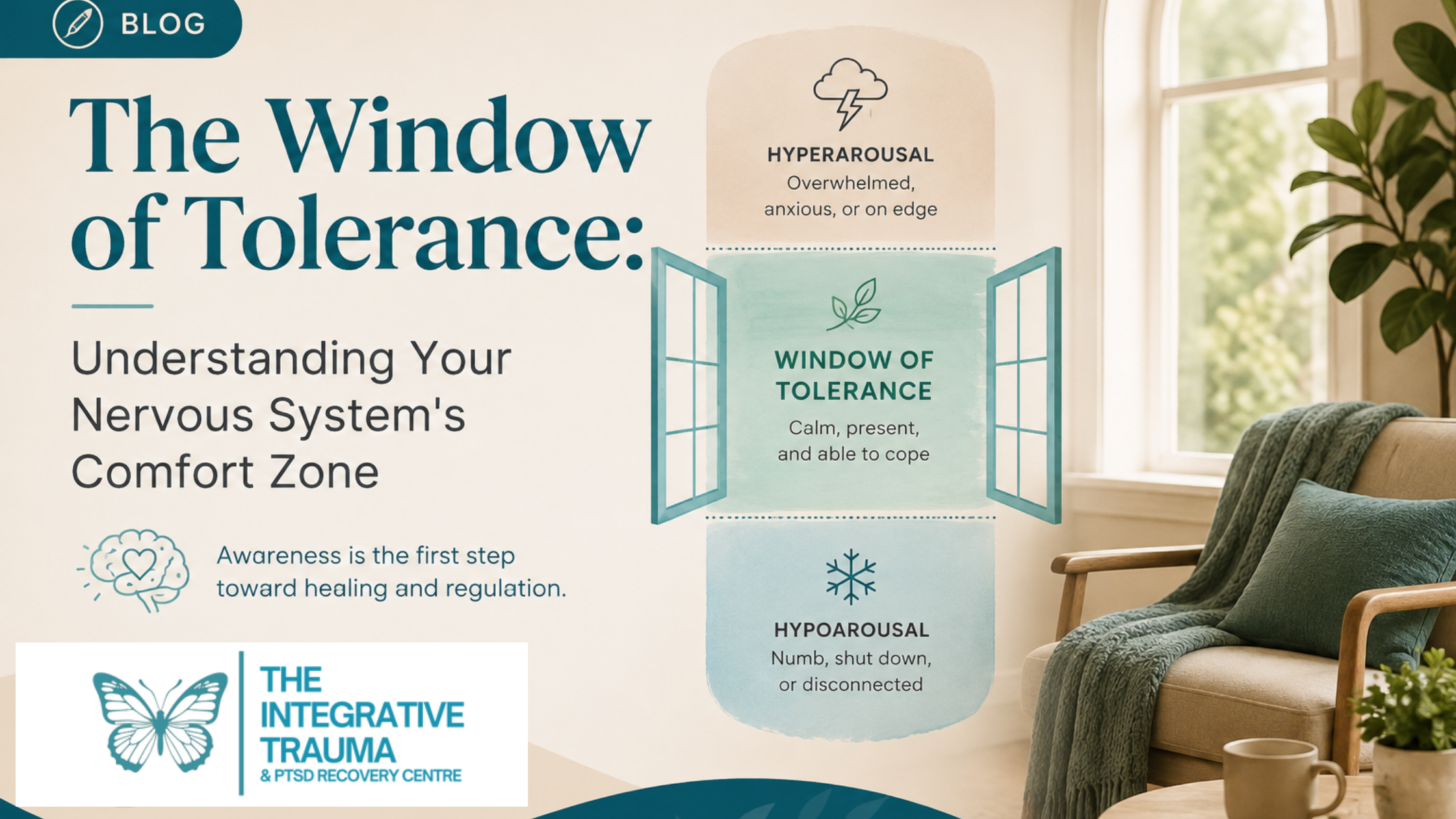
Think of your window of tolerance as the zone where your nervous system feels stable and capable. Inside this window, you can think clearly, feel your emotions without being overwhelmed, respond to situations (rather than just react), and generally feel like yourself.
When you’re inside your window, you can have a hard conversation without shutting down. You can handle stress without your body going into overdrive. You can feel sad or angry, but the feeling doesn’t take over your entire being.
The window of tolerance isn’t fixed. It shifts. A good day, good sleep, time with people you trust—these expand it. A fight with your partner, a difficult work meeting, grief—these can narrow it. That’s normal nervous system behavior.
But after trauma, something shifts. Your window doesn’t just narrow temporarily. It stays narrow. And for many people, it becomes painfully narrow.
What Happens When You Leave Your Window: Hyperarousal and Hypoarousal
When something triggers your nervous system and pushes you outside your window, you land in one of two places: hyperarousal or hypoarousal. Both feel terrible, just in completely different ways.
Hyperarousal: When Your Nervous System Is Stuck in Overdrive
Hyperarousal is what happens when your nervous system gets flooded with alarm. Your body thinks danger is present, so it floods your system with cortisol and adrenaline. You’re in fight-or-flight mode, and it won’t turn off.
What hyperarousal feels like:
- Your heart races for no reason you can name
- You startle at small sounds (the doorbell, someone coming up behind you, a phone notification)
- Your muscles feel tight, especially your shoulders, jaw, and chest
- You’re irritable, snappy, ready to fight. People say you’re “on edge” or “reactive”
- Your mind races. You catastrophize. You can’t sit still
- You feel restless, like you need to do something, anything, to discharge the energy
- Sleep is impossible, or you wake up constantly
This is what people often call anxiety or panic, but it’s really just your nervous system in emergency mode. And when you’ve been through trauma, your nervous system thinks emergencies happen all the time.
Hypoarousal: When Your Nervous System Checks Out
Hypoarousal is the opposite extreme. When your nervous system gets overwhelmed, it doesn’t always go into fight-or-flight. Sometimes it shuts down. Freeze mode. This is a survival response too—if you can’t fight or run, you play dead.
What hypoarousal feels like:
- You feel numb, disconnected from your body, like you’re watching yourself from outside
- Everything feels muted, even things that should matter to you
- You’re exhausted but not the kind that sleep fixes
- You can’t motivate yourself to do basic things (shower, eat, get out of bed)
- Your thinking gets foggy. Concentration disappears
- You feel collapsed, heavy, like you’re sinking into yourself
- Time feels strange. Hours disappear
- You withdraw from people, even people you love
Hypoarousal is what people often call depression or “just being tired,” but it’s actually your nervous system protecting you by shutting down. It’s an adaptation. It got you through the trauma. But now it’s keeping you trapped.
Why Your Window Gets So Narrow After Trauma
After trauma, your nervous system learned a lesson it can’t unlearn on its own: the world is dangerous, and you need to stay on high alert.
Your brain literally rewired itself. The amygdala (the alarm center) became hyperactive. The prefrontal cortex (the thinking, reasoning part) stepped back. Your nervous system is now set to a lower activation threshold. It takes less and less to set it off.
This makes sense evolutionarily. If you survived danger once, staying vigilant makes sense. But trauma taught your nervous system to see threats everywhere, even when you’re safe. Grocery stores, restaurants, conversations, unexpected sounds—your nervous system treats these like they’re dangerous.
So your window of tolerance shrinks. The zone where you feel okay, capable, present—it gets smaller. You spend more time in hyperarousal or hypoarousal, and less time in that middle ground where you feel like yourself.
The Window Doesn’t Heal on Its Own
This is important: your nervous system won’t naturally expand your window just because time passes. Talking about what happened, understanding why you react the way you do, being brave—these all help, but they don’t directly reset your nervous system.
What does expand your window is processing the trauma in a way that your nervous system understands. Your nervous system speaks in sensations, memories, and reflexes. It doesn’t speak in insight or rationality.
This is why somatic approaches—approaches that work with your nervous system rather than asking your thinking brain to logic its way out—are so effective for trauma recovery. This is also why EMDR therapy, which processes trauma memories in a way that lets your nervous system release what it’s been holding, can shift things so quickly.
When you process trauma properly, your nervous system gets to update its threat assessment. It learns: “Oh. That was then. This is now. I’m actually safe.”
And when your nervous system believes you’re safe, your window expands. Gradually, steadily, you spend more time inside it.
What Expanding Your Window Actually Looks Like
As your window grows, small things shift:
- You can hear a loud noise without jumping three feet in the air
- A difficult conversation with someone you trust doesn’t send you into a spiral
- You can feel sad without feeling like you’re drowning
- You can feel angry without rage taking over
- You have more capacity for joy, connection, play
- Sleep gets easier
- You can think clearly even when things are stressful
- You recognize when you’re leaving your window and you can bring yourself back, or reach out for help
You’re not aiming for a window that never closes. That’s not the goal. Even people without trauma histories have moments where they get triggered or overwhelmed. The goal is to get your window big enough that you can function, connect, and move through the world without your nervous system being in constant emergency mode.
How Trauma Therapy Expands Your Window
In Edmonton trauma therapy, expanding your window of tolerance is the foundation of everything we do. It’s not about willpower or thinking positive thoughts. It’s about directly processing the trauma memories your nervous system is still holding, so it can finally relax.
EMDR therapy (Eye Movement Desensitization and Reprocessing) is particularly effective at this because it works with how your nervous system processes information. During EMDR, you activate the trauma memory while your attention is guided back and forth. This helps your brain reprocess the memory in a way that deactivates the threat response. Your nervous system literally updates its files. “This happened, it’s over, I lived through it, I’m okay now.”
Individual therapy that’s trauma-informed also helps. A skilled therapist can help you understand your window, notice when you’re leaving it, and gradually expand your capacity to stay present and regulated, even in hard moments.
Somatic work that involves bringing awareness back into your body—noticing sensations, learning to distinguish between real danger and false alarms, gently asking your nervous system to release what it’s holding—this rewires your threshold for activation.
The window doesn’t expand overnight. But it does expand. And each time it expands a little, you get a little more of your life back.
Where to Start
If you recognize yourself in this—if you know your reactions feel outsized, if you’re stuck between hyperarousal and hypoarousal, if your window feels impossibly small—you don’t have to white-knuckle your way through it.
The first step is usually just recognizing what’s happening. You’re not broken. Your nervous system isn’t faulty. It’s doing exactly what survival taught it to do. But survival mode is exhausting, and you don’t have to stay there.
A trauma-informed therapist, especially one trained in approaches like EMDR that directly address the nervous system, can help you expand your window. And as your window expands, you’ll notice things start to shift. You’ll feel more like yourself. You’ll have more capacity for the people and the life you actually want.
ABOUT DR. CANDACE HAMILTON
 Dr. Candace Hamilton, Psy.D, Registered Psychologist, EMDR Consultant brings over a decade of specialized expertise in trauma recovery, particularly in treating complex PTSD, attachment injuries, and dissociative responses. Her approach combines evidence-based EMDR therapy with somatic awareness and relational science to help clients expand their window of tolerance and reclaim their capacity for presence, connection, and healing.
Dr. Hamilton is an EMDRIA-Approved Consultant and CE Provider (#24058), offering both direct client care and specialized training for therapists looking to deepen their trauma work. She works with individuals, couples, families, and children across Edmonton and throughout Alberta via virtual sessions.
Learn More About EMDR with Candace
ABOUT THE INTEGRATIVE TRAUMA & PTSD RECOVERY CENTRE
The Integrative Trauma & PTSD Recovery Centre (ITC) is a trauma-focused practice in Edmonton, Alberta, specializing in EMDR therapy, intensive trauma work, and relational approaches to healing complex trauma and PTSD.
Our Services Include:
- Intensive Trauma Therapy (concentrated multi-day or multi-week programs)
- Individual Therapy for Trauma Recovery
- Couples Therapy (relational and betrayal trauma)
- Children & Family Therapy
- Group Therapy for Trauma Recovery
- EMDR Therapy
- Training & Consultation for Clinicians
Service Area:
- In-person therapy: Edmonton, Alberta
- Virtual therapy: Available to residents across Alberta
Location: Unit 202A, 9129 35 Avenue NW Edmonton, AB T6E 5Y1
Contact: Phone: (587) 415-8385 Email: info@abptsdrecovery.com Website: abptsdrecovery.com
If your window of tolerance feels narrow, or if you’re caught between hyperarousal and hypoarousal, trauma therapy can help.
Book a free 15-minute consultation to explore whether EMDR or other trauma-focused approaches are right for you. Link in bio, or reach out to us directly at (587) 415-8385.